Plaster Wall and Ceiling Repair in Madison, WI

Cracked, bulging and failed plaster over wood lath, in the pre-1940 houses that fill Madison's isthmus neighbourhoods. Repaired the way plaster needs, not the way drywall does.

Call (608) 571-1660
Free estimates · historic-district houses · Madison and Dane County
Pre-1940 homes
Lath repaired properly
Plaster keys addressed
Free estimates

Plaster repair, quoted honestly

The useful things to say on the phone are the age of the house, whether the surface is cracked or actually bulging, and whether it is a wall or a ceiling. Those three set the scope. Call (608) 571-1660.

  • Cracked and bulging plaster over wood lath, not drywall
  • Failed plaster ceilings assessed before anything is touched
  • Drywall patches built out to the plaster plane, not fixed flat
  • Historic-district houses on and around the isthmus

Plaster repair in Madison: the short answer

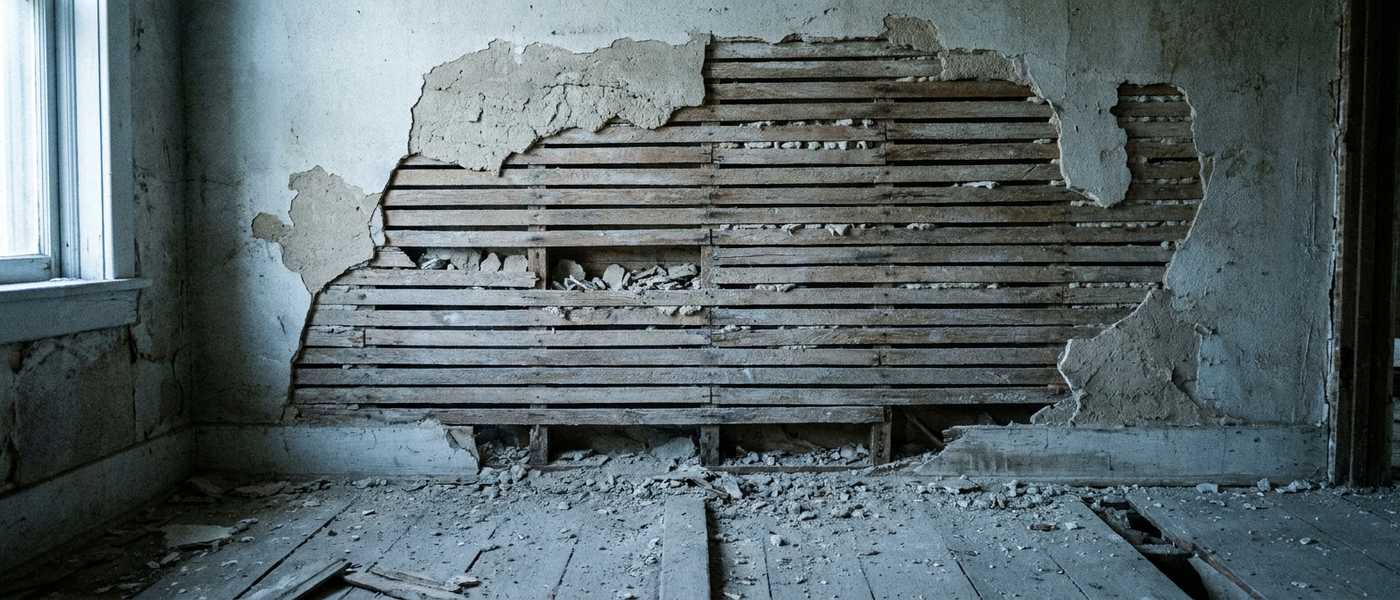
Plaster is not drywall, and a drywall repair technique applied to it fails. Plaster over wood lath holds on by keys — ridges of plaster that squeezed through the gaps between the lath strips and hooked over behind them. When those keys break, the surface loses its grip whether or not it has cracked yet. Screwing a drywall patch straight into that lath pulls more plaster down inside the cavity and the drywall repair reopens within a season. The right sequence is: find where the sound plaster stops, secure what is left back to the lath, and then build the drywall patch out to the plaster's thickness rather than to drywall's.

That thickness difference is the detail most drywall contractors get wrong in Madison. Plaster over lath is usually thicker than half-inch drywall, so a drywall patch fixed flat to the studs sits shy of the surrounding surface and shows as a shadow line under any raking light. Building the drywall out to meet the plaster plane is not a refinement; it is the difference between a repair that disappears and one you can find from the doorway.
Why Madison has so much plaster and so little drywall in its oldest houses

17,310 Madison housing units — 13.0% of everything standing — were built in 1939 or earlier, and another 5,377 went up in the 1940s. Behind the paint in most of those is plaster over wood lath, not drywall. They are not scattered evenly either: they concentrate on and around the isthmus between Lake Mendota and Lake Monona, which carries three separate historic districts.

Early Madison was described as a city of four hills: Capitol Hill, Mansion Hill, Third Lake Ridge and Fourth Lake Ridge. Three of the four are full of plaster walls, and the neighbourhoods that grew around them — Marquette and Williamson Street, Tenney-Lapham, Schenk-Atwood, Vilas, Regent — carry the same construction. If you live there, a contractor who quotes your job as a straight drywall repair has not looked at the wall.

None of which means drywall has no place in these houses. Most of them have had drywall put in somewhere already — a re-done kitchen, a finished attic, a bathroom stripped in the 1990s — so a single pre-1940 Madison house often needs plaster repair in one room and an ordinary drywall repair in the next. Establishing which is which, room by room, is the first thing that should happen on site.

Repair the plaster, or replace it with drywall?

Direct answer: repair what is sound, replace with drywall what has lost its keys, and be honest about which is which. Both are legitimate; the failure mode is choosing on price rather than on condition.

Ceilings deserve their own note. A plaster ceiling that has lost its keys is heavy and it comes down as a slab rather than as crumbs. If a plaster ceiling is sagging, keep out from under it and do not push it back up to see how loose it is. Those are the ones that most often end as a full drywall replacement, because a plaster ceiling that has started to let go rarely stops.

Whichever way it goes, the finish is the same problem as any other drywall repair in this city: the new surface has to match the old one. Pre-1940 Madison walls carry hand-applied plaster finishes rather than sprayed drywall texture, so the match is troweled rather than sprayed. See drywall texture matching for how that is established before anything is applied.

Plaster walls, not drywall?

Say the age of the house and whether the surface is cracked or bulging. That is usually enough to say whether it is a plaster repair or a drywall replacement.

(608) 571-1660

Plaster, lath and drywall repair — common questions

How do I tell whether my walls are plaster or drywall?

Two quick checks. Push a drawing pin into an inconspicuous spot: it goes into drywall with light pressure and refuses to go into plaster at all. Then knock. Drywall gives a hollow, drummy sound between studs; plaster over lath sounds denser and duller, with a faint gritty quality. Age is the other clue. In Madison, a house from before about 1940 is very likely plaster, and 17,310 units in this city fall into that group.

What are plaster keys and why do they matter?

When plaster was applied to wood lath, it was pushed through the gaps between the lath strips and slumped over behind them, forming ridges that hooked the plaster onto the wall. Those ridges are the keys, and they are the entire structural principle of the wall. When they crack off through age or vibration, the plaster loses its grip on the lath and starts to bulge, sound hollow, and eventually fall in a sheet. That is why pressing a bulging plaster wall to test it is a bad idea, and why filling the crack on the surface changes nothing.

Can plaster just be replaced with drywall?

Often, and it is frequently the right call for a bad section. A drywall patch cut to match the plaster's thickness, fixed to sound framing and blended into the surrounding surface is a durable, honest repair. Where it goes wrong is thickness: plaster over lath is usually thicker than half-inch drywall, so a patch fixed flat to the studs sits proud or shy and shows as a shadow line. Building the patch out to meet the plaster plane is the part that takes the time.

Is my old plaster worth saving?

Where it is sound, yes, and not only for heritage reasons. Old plaster is thicker, denser and better at deadening sound than modern drywall, and in Madison's historic districts it is part of what the house is. The judgement is about extent: isolated cracks and one failed section are worth repairing, while a ceiling where most of the keys have gone is usually safer and cheaper to take down and replace with board.

Why does my plaster ceiling sag in the middle?

Because plaster ceilings fail before plaster walls do, and for a simple reason: gravity pulls a ceiling straight off its keys, while a wall is only asked to stay upright. A sagging plaster ceiling has lost a significant share of its keys and it is genuinely heavy. Keep out from under it, do not push it back up, and have it looked at rather than tested by hand.

Tap to Call — (608) 571-1660