Ice dams, roof leaks, burst supply lines and the unit upstairs. Wet drywall comes out, the cavity dries properly, new board goes in and the texture is matched.
Call (608) 571-1660The two things worth saying on the phone are where the water came from and roughly how long it has been there. Those set the whole scope of the drywall repair. Call (608) 571-1660.
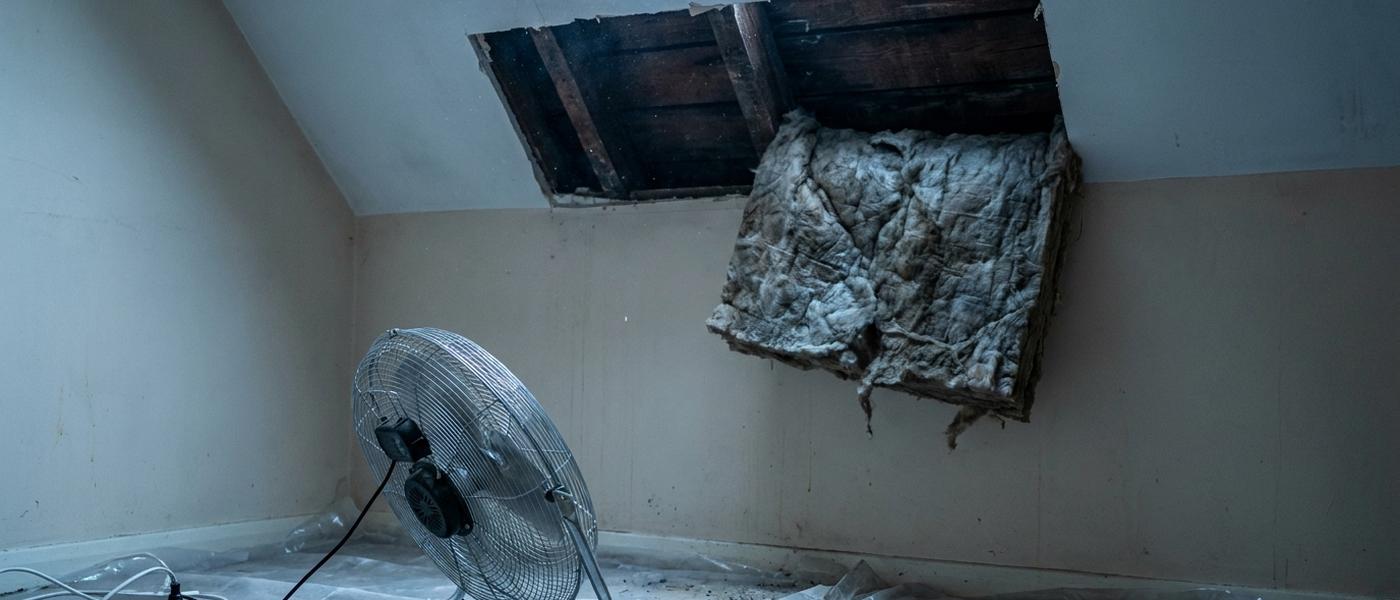
Stop the water, dry the cavity, then repair the drywall — in that order, every time. A water damage drywall repair done in the wrong order looks finished for about six weeks and then bleeds a stain back through the fresh paint. Wet drywall that has lost the strength of its paper facing does not recover when it dries; that drywall has to come out. Wet insulation does not recover its R-value either, and it stays damp inside a closed cavity for a very long time.
That sequencing rule is the whole page. Almost every failed water damage drywall repair in this city failed because somebody closed the wall before the wall was dry.
Madison averages 51.8 inches of snow in a normal season, on the 1991–2020 climate normals kept by the Wisconsin State Climatology Office at UW–Madison — and the record season, 2007–08, ran to 101.4 inches. That snow is not a drywall problem while it stays frozen on the roof. It becomes one at the eave.
The mechanism is the ice dam, and it is the single largest driver of ceiling drywall repair in this city. Warm air leaks out of the living space into the attic through can lights, plumbing penetrations and gaps in the insulation. It heats the underside of the roof deck. Snow on that warmed section melts, runs down toward the cold overhang, and refreezes into a solid ridge of ice at the gutter. Every later melt then backs up behind that ridge and finds its way under the shingles. University of Minnesota Extension and Focus on Energy, Wisconsin's statewide energy programme, both describe the same chain, and both note that older homes are at higher risk because of thinner insulation and poorer attic ventilation — which, in a city where half the housing stock predates 1980, is most of Madison.
What arrives inside is bubbled paint, a stained ceiling, sagging drywall and soaked insulation that has lost most of its R-value. The ceiling drywall repair is the visible half of that job. Stopping the water is the other half, and it has to come first — a drywall repair applied over a live leak fails, every time.
The practical consequence for a drywall repair is a sequencing rule. If the roof has an ice dam and it is still February, the ceiling drywall repair can be scoped and the wet drywall removed, but the finish coat is often better held until the freeze-thaw cycle has finished for the season and the cavity has genuinely dried. Any contractor who wants to close and paint drywall in the middle of a live ice-dam winter is optimising for their schedule rather than your ceiling.
It also means the drywall repair is only ever half the fix. The other half is the attic air sealing and insulation work that stops the dam forming, and that is a different trade. A drywall contractor who tells you the drywall repair alone will stop it happening again is telling you what you want to hear.
A water damage drywall repair carried out in that order is permanent. One carried out in any other order is a deposit on the same drywall repair next year.
Say where it came from and how long it has been there. That is enough to scope whether it is a patch, a section, or a dry-out first.
(608) 571-1660Press it gently. Drywall that has been wet and dried usually still feels firm but looks discoloured, and that can sometimes be sealed and re-finished. Drywall that gives, feels spongy, crumbles at the edge of the stain or has visibly sagged has lost the paper facing that gives it its strength, and it needs to come out. If the stain sits on a ceiling and is bigger than a dinner plate, assume replacement and be pleasantly surprised if it is not.
Longer than the surface suggests. The face can feel dry in a day while the core and the cavity behind it stay wet for a week or more, especially in a closed-up Wisconsin house in winter. That is exactly why a rushed water damage drywall repair fails: the finish goes on over trapped moisture, and the stain bleeds back through the new paint. Open the cavity, move air through it, and confirm it is dry before anything is closed up.
No, but time is the variable that decides it. Mould needs moisture, a food source and time, and drywall paper and wet insulation are an excellent food source. Water that is found and dried quickly usually does not produce a mould problem. Water that has been running quietly behind a wall for months often does. If there is a musty smell rather than just a stain, say so on the phone, because it changes how the drywall repair is approached and it may need a specialist rather than a drywall contractor.
It is a ridge of ice that builds at the cold edge of a roof and stops meltwater draining off. Warm air escaping into the attic heats the roof deck, snow melts on the warm section, the water runs down to the cold overhang and refreezes. Each thaw adds to the dam and the water backs up under the shingles. It keeps happening because the underlying cause is attic air leakage and insulation, not the roof itself, and repairing the ceiling drywall without addressing that guarantees a repeat next winter. Focus on Energy, Wisconsin's statewide energy programme, publishes homeowner guidance on the insulation and ventilation side.
Before, and photograph everything first. Once wet board is cut out, the evidence goes in a bin bag. Sudden and accidental water is commonly covered; long-term seepage usually is not; ice-dam damage varies by policy. That is a conversation with your carrier, not with a drywall contractor, and it is worth having before the saw comes out.